

For two minds. From one truth.
For most of modern marketing, brands have been built on one simple assumption: the human was both the audience and the decision-maker.
We built awareness so people would notice, memory so they would remember, positioning so they would associate the brand with something distinctive, and desire so that, when the moment of choice arrived, one brand would feel more relevant, more trusted, or simply more wanted than another.
Technology changed how we did this. Television gave way to digital. Search reshaped discovery. Social media redistributed influence. Data made targeting more precise. Commerce moved closer to communication. But the underlying logic remained largely intact: there was a human being on the other side.
AI begins to change that. Not because AI becomes another consumer, but because AI becomes another interpreter of value. Increasingly, people will ask AI systems to discover, compare, evaluate and narrow choices on their behalf: Find me a reliable vacuum cleaner for a small apartment with wooden floors and a cat. Which hotel is best for my family if convenience matters more than luxury? Compare these software platforms and tell me which one fits a company our size.
In each case, the human still has the need, makes the purchase and experiences the product. Ultimately, the human still matters most. But another intelligence increasingly influences what reaches the human for consideration in the first place. That changes something fundamental about brand building.
For the last 50 years, we built brands to live in human memory. What happens when another intelligence increasingly mediates human choice?
We believe brands are entering an era in which they must be built for two minds: the human mind and the machine mind. Not because they think alike, but precisely because they do not.
Two Minds. Two Different Judgments.
The human mind asks: Do I want this? It responds to meaning, memory, emotion, identity, familiarity, culture, experience and desire.
The machine mind asks a different question: Should I recommend this? It looks for relevance, evidence, performance, compatibility, reliability, context and trade-offs.
This distinction matters. AI does not create a second customer. It creates a second interpreter between the brand and the customer.
Brands therefore should not simply learn how to “market to AI.” That would misunderstand the change. The challenge is different:
Do not market to machines. Make your value intelligible to them.
At the same time, do not reduce humans to machines. Give them something worth desiring. The future strength of a brand may increasingly depend on its ability to win both judgments:
DESIRED BY HUMANS × RECOMMENDABLE BY MACHINES
That is a fundamentally different brand-building problem, and it starts much deeper than communication.
From Mental Availability to Machine Retrievability
One of the great ideas of modern brand building is mental availability: strong brands are easier to retrieve from memory when a buying situation occurs. That remains important.
But consider what happens when someone asks an AI: “I need a vacuum cleaner for a 70-square-meter apartment. I have a cat, wooden floors, I hate noisy appliances, I don't want much maintenance, and my budget is around $300.”
The consumer no longer needs to remember ten vacuum cleaner brands. The AI can do that. More importantly, remembering them is not enough. It needs to understand what each brand offers, under what circumstances it performs well, how it differs from alternatives, and whether the available evidence supports that difference.
A new form of availability therefore becomes important: Machine Retrievability.
Can an intelligent system find your brand? Can it understand what you actually offer? Can it distinguish you from competitors? Can it recognize the situations in which you are unusually relevant? And can it access enough evidence to recommend you with confidence?
The brand-building equation begins to expand:
Human Mental Availability × Machine Retrievability
One makes the brand easier to remember. The other makes its value easier to retrieve and understand. Strong brands will increasingly need both.
From Brand Promise to Brand Evidence
For decades, companies have had considerable power to define themselves. We are innovative. We are premium. We care about customers. We make better products. We are sustainable. Communication could repeat these claims until they became familiar associations.
AI introduces a different dynamic: it can increasingly compare what a company says with what the world can observe.
A brand claims durability; AI can examine product specifications, warranties, expert reviews, repair discussions and thousands of customer experiences. A hotel calls itself family-friendly; AI can examine room configurations, facilities, location, policies and what families actually say about staying there. A company promises exceptional service; AI can increasingly see what happened after the product failed, the delivery arrived late or the customer asked for help.
The distance between Brand Promise and Business Reality becomes easier to inspect.
This changes the question brand leaders need to ask. It is no longer only, “What do we want people to believe about us?” Increasingly, it must also be:
What is demonstrably true about us?
This may be one of the most important shifts AI brings to branding.
Brand building moves from the art of making promises toward the discipline of accumulating evidence.
That evidence cannot be manufactured by the communications department alone. It comes from the business itself: its products, services, experiences, pricing, distribution, innovation, customer relationships and, ultimately, what the company repeatedly does. AI does not create this truth. It simply makes truth harder to avoid.
When Meaning Becomes the Scarce Resource
AI is extraordinarily good at comparison. Give an intelligent system thirty alternatives and it can quickly identify where they differ — and where they do not.
This creates a problem for brands built on generic language: quality, innovation, sustainability, customer-centricity, premium experience, trusted partner. Almost every company can say these things, which means they contain increasingly little information.
If thirty companies claim innovation, an AI can ask: Innovative in what way? If twenty products promise quality: Better according to which measure? If every company claims to be customer-centric: What observable behavior makes one meaningfully different?
AI therefore creates an interesting paradox. It makes the production of communication almost infinitely abundant, but abundance reduces value.
When everyone can generate more content, more content stops being an advantage. When everyone can personalize, personalization stops being an advantage. When everyone can produce polished creative work, production quality alone stops being an advantage.
The scarce resource moves somewhere else: toward meaning, difference, truth and things that cannot simply be generated. This is why we believe the future of marketing is not personalization. Personalization is becoming infrastructure.
The harder question is:
What deserves to be personalized?
AI can solve the economics of expression. It cannot solve the problem of meaning.
From Positioning to Legible Distinctiveness
Traditional positioning asks: What do we want to stand for in the customer's mind?
That remains a powerful question. But another now needs to sit beside it:
What makes us meaningfully distinguishable when an intelligent system compares us with every reasonable alternative?
A brand cannot answer that with adjectives alone. “Premium” is not a difference. “Innovative” is not a difference. “High quality” is not a difference.
A meaningful difference has structure. It needs to explain for whom the brand is unusually valuable, under what circumstances, what problem it solves particularly well, through what mechanism, compared with which alternatives, at what trade-off, and supported by what evidence.
This is what we mean by Legible Distinctiveness. A difference must remain meaningful to humans, but it must also become clear enough that another intelligence can recognize why that difference matters. Brand strategy therefore expands from creating a position to creating a structured system of meaning:
This is where we create unusual value, this is how we create it, and this is why you can believe us.
From Audience Segments to Human Intent
Marketing has spent decades becoming more sophisticated at segmentation — by age, income, location, life stage, interests and behavior. These abstractions were useful because understanding millions of individuals independently was impossible.
AI changes that constraint. A 35-year-old woman living in Singapore is not always the same consumer. Today she may want the safest car for her children. Tomorrow she may want an exciting restaurant for an anniversary. Next month she may buy something purely for herself. Her demographic profile barely changed. Her intent changed completely.
AI can increasingly understand not merely who someone is, but what that person is trying to accomplish right now: under what conditions, with which preferences, within what constraints, accepting which trade-offs, and prioritizing what over what. This changes the strategic question.
The old problem was:
Which message should we send to this audience?
The emerging problem is:
Under which intentions are we genuinely the best answer?
That requires something deeper than a campaign message. Brands need a system of value propositions capable of responding to different contexts without losing their underlying identity.
One brand. Many situations. Many expressions. One coherent meaning.
Infinite Expression Changes What Brand Consistency Means
Brand management was designed in an era of relatively scarce expression. Companies produced a manageable number of campaigns, advertisements, brochures, websites, retail materials and sponsorships. Governance therefore naturally focused on controlling what went out: logo, color, typography, photography, tone of voice and key messages.
AI radically changes the economics of expression. Soon, a brand may generate thousands of creative variations. Creators will reinterpret it. Commerce platforms will describe it differently. Conversational agents will explain products dynamically. Personalized communication may be generated at the moment of interaction.
Trying to make every expression identical becomes impossible — and perhaps unnecessary. The more important question is:
If expression becomes infinite, what must remain fixed?
Our answer is meaning: the truth of the product, the truth of the brand, the mechanism through which it creates value, its distinctive meaning, the evidence behind its claims and the boundaries of what it can credibly promise.
These should become the stable core. Around that core, expression can become radically freer across creators, stories, formats, languages, contexts and personalized interpretations. This suggests a different operating principle for brand governance: Fix the Meaning. Free the Expression.
The old brand system was designed primarily to control expression. The AI-native brand system must be designed to preserve meaning through infinite expression. Consistency no longer requires everyone to say the same thing. It requires everything the brand says to originate from the same truth.
From Customer Journey to Human–Agent Journey
As these changes compound, something larger happens to the customer journey itself.
Today, we typically imagine a journey such as:
Need → Search → Content → Comparison → Store → Purchase
AI can compress several of those stages. The emerging journey may increasingly become:
Need → Personal AI → Evaluation → Recommendation → Purchase
For some categories, it may eventually evolve further:
Human Intent → Personal AI ↔ Brand / Commerce AI → Action
Parts of the decision may therefore happen without the customer ever seeing the advertising, product page or comparison chart that marketers carefully created. This does not make branding irrelevant. It changes where brand power needs to exist.
The human side still responds to meaning, memory, emotion, identity and desire. The machine side increasingly depends on legibility, evidence, relevance, reliability and context. Machines may become exceptionally good at answering:
Does this choice make sense for you?
But humans still answer a different question:
Is this the choice I want to make?
These functions are not competing. They are complementary. A machine can validate a choice. Only the human can desire it. The future brand therefore cannot merely become more machine-readable. It must become simultaneously more structured in truth and more human in meaning.
From Share of Voice to Share of Recommendation
The age of mass media gave marketers Share of Voice. The digital era added search visibility, traffic, engagement and conversion. An AI-mediated market may make another measure strategically important: Share of Recommendation.
Within the situations where a brand genuinely has the right to win, how often does it enter the consideration set? How often is it recommended? Against whom? Under which intentions?
And most importantly:
Why?
That question changes marketing profoundly. If another product is recommended because it is more reliable, another campaign does not solve the problem. If customers consistently prefer a competitor because installation is easier, communications cannot manufacture away that disadvantage. If a brand disappears from recommendation because its claims cannot be verified, the answer may lie in product, data, customer experience, distribution or evidence.
Brand management therefore moves closer to the operating core of the business. Marketing connects to product; product to experience; experience to evidence; evidence to reputation; and reputation back to recommendation.
Brand increasingly becomes the interpretable consequence of how the business behaves.
When Everyone Has AI, AI Stops Being the Advantage
Today, access to AI still feels like an advantage. It will not remain one.
Everyone will have AI. Content production will become cheaper, research faster, personalization ubiquitous, media optimization increasingly automated, and competitive intelligence abundant. Capabilities that once required specialized teams will become accessible to almost every company.
The strategic question therefore eventually changes from:
How can we use AI better?
to:
What remains scarce when everyone has AI?
The answers are surprisingly human: a genuinely superior product, a distinctive point of view, proprietary knowledge, trust accumulated over time, customer relationships, culture, community, reputation, taste, real experience, the courage to stand for something, and the organizational ability to make what you promise consistently true.
AI does not make these things obsolete. It makes them more valuable. Because when expression becomes abundant, reality becomes scarce.
The Next Evolution of Brand
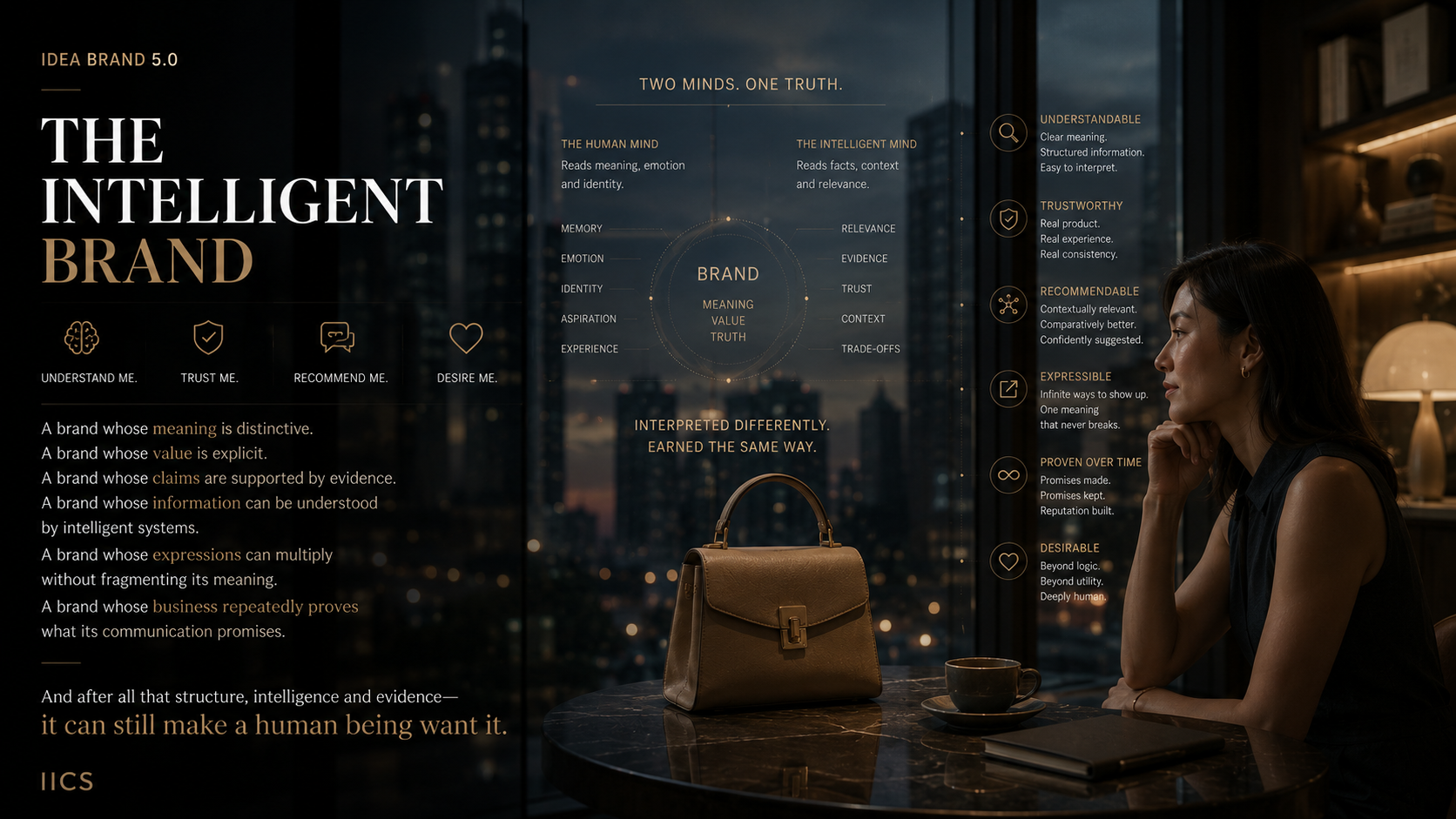 The history of branding can be understood as a continuous expansion of what a brand needs to do.
Brand 1.0 — Identity: Recognize me.
Brands helped people identify one product from another.
Brand 2.0 — Positioning: Remember what I stand for.
Brands competed for distinctive territory in human memory.
Brand 3.0 — Experience: Experience what I promise.
Companies learned that every interaction had to reinforce the promise.
AI may now force another expansion.
Brand 4.0 — Evidence: Verify why I deserve to be chosen.
Claims become connected to observable reality.
And beyond that lies what we believe will define the next generation of strong brands:
Brand 5.0 — The Intelligent Brand
Understand me. Trust me. Recommend me. Desire me.
An intelligent brand has distinctive meaning and explicit value. Its claims are supported by evidence; its information can be understood by intelligent systems; its expressions can multiply without fragmenting its meaning; and the business repeatedly proves what its communication promises.
And after all that structure, intelligence and evidence, it can still make a human being want it.
For Two Minds. From One Truth. AI will not make brand less important.
It will make weak brands easier to expose.
When information becomes abundant, claims become cheap. When expression becomes infinite, controlling every expression becomes impossible. When comparison becomes effortless, generic differentiation disappears. And when every company has access to intelligence, intelligence itself stops being scarce.
What remains is harder to manufacture: something genuinely different, demonstrably valuable, consistently true — and something human beings still want.
This is why we do not believe the future of branding is about designing brands for machines, nor is it about protecting brands from machines. It is about building businesses whose value can survive interpretation by both.The machine should be able to understand why the brand deserves to be recommended. The human should still be able to feel why the brand deserves to be chosen.
Two different minds. Two different judgments. But they should not require two different brands. They should arrive at the same brand from the same underlying truth. That is the brand we believe is worth building.
For two minds. From one truth.
— IICS